
Nathan’s Treatment Scale – Recommendation (NTS‑R)… for Clinicians
 It’s not always realistic for a doctor or other clinician to explain the pros and cons of a particular treatment and then expect the patient to make an informed decision. Few patients have the science background to judge the merits of a treatment’s effectiveness and possible side effects. Besides, available evidence may not apply well to an individual’s particular circumstances. Patients need their health care professionals’ guidance, and clinicians would benefit from an efficient means of quantifying how strongly they favor or oppose a particular treatment.
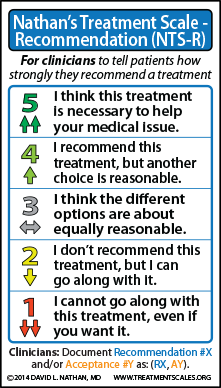
When a patient requests a clinician’s opinion about a treatment, and it isn’t a straightforward one, the NTS‑R provides five levels of recommendation that are easily comprehensible:
Level 1: “I cannot go along with this treatment, even if you want it.”
This level is used in situations when patients request a treatment option that lies clearly outside the standard of care or good medical judgment.
Level 2: “I don’t recommend this treatment, but I can go along with it.”
This level is useful when a patient chooses a treatment option that is not the clinician’s preferred option, but the clinician is comfortable supporting the patient’s choice. This allows clinicians to offer a mildly dissenting opinion without labeling the patient as uncooperative or non-compliant.
Level 3: “I think the different options are about equally reasonable.”
This is a gentle way of telling a patient that the clinician is “on the fence” about the right approach. Clinicians might not experience much discomfort about their inability to predict which choice will likely prove best. But patients can be understandably anxious about such ambiguity when their health is at stake, and they may be reassured to know that either decision is “smart.”
Level 4: “I recommend this treatment, but another choice is reasonable.”
This level makes clear to patients that they can disagree with their clinician without fear of reproach if they don’t follow the clinician’s advice.
Level 5: “I think this treatment is necessary to help your medical issue.”
As with Level 1, a clinician may not need the NTS‑R to express such an unequivocal preference, but when used, it sends a strong message—especially in contrast to Level 4. If patients refuse what clinicians believe to be a necessary treatment, clinicians may question—either silently or openly—whether they can help those patients with their medical issues. Clinicians may ask patients to agree to reconsider a recommendation if their condition is unimproved at a specified later point in time.