

Nathan’s Treatment Scale – Acceptance (NTS‑A)… for Patients
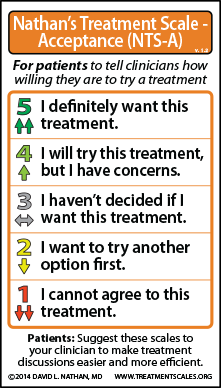 The NTS‑A empowers patients to tell clinicians how willing they are to try a treatment, which is useful when the decision isn’t obvious and/or patients feel uncomfortable putting their ambivalence into words.
If patients are at all undecided about a clinician’s treatment recommendation, they can use the NTS‑A to give the clinician feedback about their level of acceptance of that treatment. The five levels of the NTS‑A closely parallel the NTS‑R:
Level 1: “I cannot agree to this treatment.”
This is a contrary opinion that patients might not state so explicitly if they were not prompted to do so. The wording used intentionally avoids the question of whether a patient might be willing to reconsider the treatment in the future, leaving the door open to another discussion at a later date. And if the clinician solicits the patient’s reasons for refusing the treatment, then he or she might learn more about the patient’s priorities and possibly allay the patient’s concerns about the treatment.
Level 2: “I want to try another option first.”
By choosing this level, patients can say “not now” while allowing either party to revisit the option in the future. As with Level 1, this choice can initiate a discussion about the patient’s reluctance, and the clinician may be able to provide the patient with needed reassurance about the treatment.
Level 3: “I haven’t decided if I want this treatment.”
This choice can also facilitate further discussion about the treatment, but can also serve as a concise endpoint to discussion when the patient wants more time to consider his or her options before making a decision.
Level 4: “I will try this treatment, but I have concerns.”
This allows patients to note reservations about a treatment that they still regard as the best available option.
Level 5: “I definitely want this treatment.”
Patients who choose this level will often express such an unequivocal decision without even using the scale, though documentation of Level 4 vs. Level 5 makes clear that the clinician offered the patient the opportunity to express any concerns about the treatment.